
My blog has moved! Redirecting...

You should be automatically redirected. If not, visit http://www.dataminingblog.com and update your bookmarks.

Data Mining Research - dataminingblog.com: search engine

I'm a Data Miner Collection (T-shirts, Mugs & Mousepads)

All benefits are given to a charity association.
Showing posts with label search engine. Show all posts

Tuesday, March 11, 2008

Google mines behavioral data

For what? Simply to improve their SERP (Search Engine Result Pages). The ultimate aim of Google is to help users to find the information they are looking for (at least it should be their aim). By mining data they have gathered from Google Toolbar, Google Analytics, Feedburner (it is now part of Google) and certainly other free tools, they are certainly trying to get better SERP.

Maybe some of you already thought it was the case. This news is giving a better insight regarding this issue. However, as it is often the case when making conclusions from experiments, their finding is maybe not generalizable to other webpages. This news has thus to be taken with caution. Maybe some of you have an opinion about this? Feel free to comment.

Continue reading... Sphere: Related Content

Wednesday, February 27, 2008

Adding websites to the Data Mining Search Engine

Since its start a few months ago, the Data Mining Search Engine keeps growing. The number of queries on this custom search engine has reached the 1000. There are now 86 websites indexed and 18 contributors. See the links on the right sidebar of this blog for contributing to the search engine website list (even with your own website or blog, if it is related to data mining).

In this post, I would like to present Google Marker, a simple way to add websites to an existing custom search engine such as the Data Mining Search Engine. The Google Marker consists of a simple button you can add to your browser. It will look like this:


And each time you find an interesting data mining website or blog, you just need to click on the button (you need to be a contributor of the search engine) to add the page.

Note that you can now access the Data Mining Search engine with its tiny URL:
http://tinyurl.com/35c9jn

If you find it useful, feel free to add it to your own website or blog.

Thanks to Shane Butler for the Google Marker tip.

Continue reading... Sphere: Related Content

Thursday, January 31, 2008

Searching for data mining contents

The Data Mining Search Engine is now active for about two months. More than 600 queries have been made during this period. At his time only 46 sites have been added. However, I will soon add other data mining websites. The main advantage of using such a customized search engine (instead of Google) is to avoid advertising sites, spams, etc. By using the Data Mining Search Engine, your query will go through the whole web, but with a strong focus on the listed sites.

Interested people can also contribute to the search engine by adding websites that are related to data mining. Currently, there are 12 contributors to this search engine. If you are not yet a contributor you can do it now.

Continue reading... Sphere: Related Content

Monday, December 10, 2007

New data mining search engine

After some discussions on KDnuggets forums, I have started a new Google search engine related to data mining:


The aim of such a search engine is to gather contributions of several people in the domain of data mining. Everybody interested can participate by adding websites, forums, news, research articles, white papers, blogs, etc. that are related to data mining.

The links you can provide are not restricted to data mining, but should be related to one of the following topics:
  • Data mining
  • Machine learning
  • Knowledge discovery
  • Pattern recognition
  • Exploratory data analysis
  • Data visualization
More than 30 links have already been added, but don't hesitate to add your website/blog if you have one which is not already listed. The idea of such a search engine is that the quality of results should be better than simply using Google since websites are manually added. At the moment, the search is done on the whole web with a strong focus on the added links. Once the number of links is high enough, I will change the options so that only manually added links will be searched. Feel free to post a comment if you have any suggestion.

Continue reading... Sphere: Related Content

Friday, November 16, 2007

Small book review: Web Dragons

Data mining is a field which is closely related to information extraction and search engines. Web Dragons: Inside the Myths of Search Engine Technology explains everything you want to know about search engines (the so called "web dragons") and how they work. Before reading the book, you perhaps wonder why Witten and co-authors called search engines "web dragons". After reading the book, I'm sure you will understand why. Search engines are guardians of the world information and their power is formidable.

The approach is descriptive and historical rather than technical. Thus, the book is intended to a wide audience: people working with data, librarians, webmasters, but also search engine users who wants to know more about the tool they use everyday. The first author, Ian Witten, is involved in the data mining field (see for example the famous book Data Mining (Witten and Frank, 2005). The book thus makes many allusions to data mining applications. It is divided as follows:

  • Setting the scene
  • Literature and the web
  • Meet the web
  • How to search
  • The web wars
  • Who controls information?
  • The dragons evolve
The two first chapters cover the history of search engines (starting from the very beginning: writing, etc.). You can easily skip these chapters (which maybe interesting to librarians for example) and start with the third one. There, you learn everything about the web, protocols, programming languages, etc. The strength of the book is to cover all these topics in a readable manner. You never face code or pseudo-code, only clear and interesting descriptions. The next chapter covers basics of search engine ranking (e.g. PageRank) in details and much more. Principal search engines are also introduced and explained. The following chapter (The web wars) explains the different ways of abusing such search engines (link boosting, term boosting, link farm, spam, etc.). The chapter is very interesting and instructing.

The next chapter (Who controls information?) points out the power of web dragons. They control world information and this raises privacy and copyright issues. Finally, the last chapter covers evolution of search engines. According to the authors, we are at the very beginning of information search. They focus on web communities that maybe the next step for search engine. As a conclusion, I recommend this book to anyone that is interested in how search engines work and especially how important they are for our society.

Web Dragons: Inside the Myths of Search Engine Technology (Witten et al., 2007).

Continue reading... Sphere: Related Content

Thursday, March 08, 2007

The future of search engines

Mining the web for information relevant to the user is the main task of search engines. According to a recent article on TechNewsWorld, Google will not be on the top forever. The author has interviewed the president of SiteSpect, a provider of search engine marketing and Web optimization technology, for details about future of search engines. According to him, in the future of search engines Google is no more on the top.

This pessimist view of Google's future is supported by the fact that people are working on new search engines that provide different information to the user. According to Larry Kerschberg, a professor at George Mason University, complicated query such as "What is the best way to treat my cancer?" is the kind of questions that search engines should be able to answer tomorrow. Even if Google's role may be less important in a few years, it will certainly be in our everyday life with popular applications such as GMail and others.

Continue reading... Sphere: Related Content

Thursday, January 18, 2007

What Google can't mine

While I was reading a book about search and information, I found a particular chapter about the hidden web very interesting. Basically, the hidden web is the part of the Internet that is accessible to people but not to bots (such as Google bots). In other words, these pages exist, but they are not referenced in search engines simply because it is too difficult (or sometimes impossible?) to index them. Examples are dynamically generated webpages, most databases behind websites, pages requiring password access, etc. More details can be found on wikipedia under the term deep web.

Michael Bergman is estimating the size of the hidden web as 400-550 times the visible web. I think the metaphor of an iceberg can easily be used in this situation. The question now is how will Google and other search engines do to access this (or at least part of this) information?

Continue reading... Sphere: Related Content

Friday, November 03, 2006

When web mining meets clustering

Google is nowadays the most widely used search engine on the planet. A lot of people use it and are satisfied by its performances. However, Google suffers from several drawbacks. For example, a lot of results are redundant. It sometimes happens that Google gives you too much answers. Assume that you have an information on a .pdf file linked from a specific webpage itself belonging to an overall website. Google will perhaps give you three different links (the main website, the specific webpage and the .pdf file itself). Another drawback of Google (and many other free-text search engine) is the lack of structure among results. Information is given in a raw manner, without themes, hierarchies or categories. So, it often happens to be drowned under the information obtained. A search on the term data mining, for example, results in 52,600,000 hits.

Clusty, a recent search engine (Pittsburgh, 2004), is a good alternative to Google. Clusty is a meta search engine, which means it queries top search engines and combines the results for the user. Clusty use clustering techniques to group results into categories. The results are automatically clustered according to selected key-words. For the example of the term data mining, Clusty proposes 246 results that are part of 36,244,144 hits found. The figure below shows the results obtained.
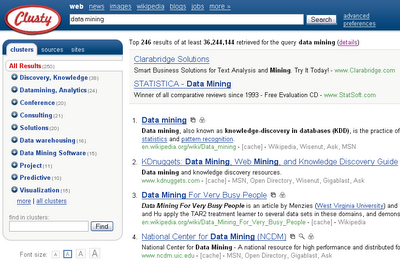
Click on the picture to enlarge.

Clusty proposes clusters and sub-clusters that can be browsed (left part of the figure). Information is not raw as in Google, but rather organized. Up to now, the only drawback I have noticed regarding Clusty is about ads. They are to close to the results obtained and this sometimes induce confusion to the user.

Continue reading... Sphere: Related Content
 
Clicky Web Analytics